Your Villa Kitchen Renovation – Is It Worth Opening It Up?



Nathan Strawbridge
Director
If your villa kitchen feels like an afterthought tacked onto the back of the house, you're not imagining it. Here's what's possible – and whether it's worth doing.
If you own a villa, there's a good chance your kitchen is doing you dirty. It's probably tucked away at the back of the house, cut off from the dining room, a bit poky, and not exactly flooded with natural light. You cook dinner while the rest of the family is in another room, and when you have people over, whoever's on kitchen duty misses half the conversation.
It's not your fault – and it's not a design flaw either. It's just how villas were built. A hundred-odd years ago, the kitchen was a working room, not a social one. It was kept separate from the rest of the house on purpose. The problem is that Kiwis today live very differently. We want open spaces, natural light, a kitchen that connects to the dining area and ideally flows out to the deck. What made sense in 1910 just doesn't work for modern family life.
So the question a lot of villa owners eventually ask is: can we fix this? And is it actually worth it?
The short answer is yes – but there's more to it than knocking down a wall and calling it done.

Why are Villa Kitchens the Way They Are?
Most villas follow a similar layout. The main rooms – lounge, bedrooms, hallway – run along the front and middle of the house, and the kitchen and scullery were added onto the back, often as a lean-to or minor addition. This meant the kitchen was physically separated from the rest of the living space, usually with a closed door between them.
That layout also meant less natural light. The kitchen was often in the shadow of the main house, with small windows and low ceilings. If you've ever felt like you're cooking in a bunker, that's why.
You'll find this in villas right across Auckland – Ponsonby, Grey Lynn, Freemans Bay, Herne Bay, Mt Eden, Epsom – and equally in the character homes of Hamilton suburbs like Frankton, Claudelands, and Hamilton East. The same era, the same building approach, the same result.
Over the decades, many of these kitchens have been updated cosmetically – new benchtops, maybe a lick of paint – but the bones haven't changed. The fundamental problem remains: the kitchen is still in the wrong place, doing the wrong thing.
What "Opening It Up" Actually Means
When people talk about opening up a villa kitchen, they usually mean one or more of the following: removing the wall between the kitchen and the dining area to create one connected space, raising or relocating beams that sit low and divide the room, adding skylights or larger windows to bring in more light, or extending the back of the house to create a larger kitchen and living area that flows out to the backyard.
In some cases, it's a relatively contained project. In others – particularly where structural walls are involved – it's a more significant piece of work. The key thing to know is that many villa kitchens share a wall with load-bearing structure, which means you can't just swing a sledgehammer and hope for the best. A good builder will assess what's holding what up before anything comes down.
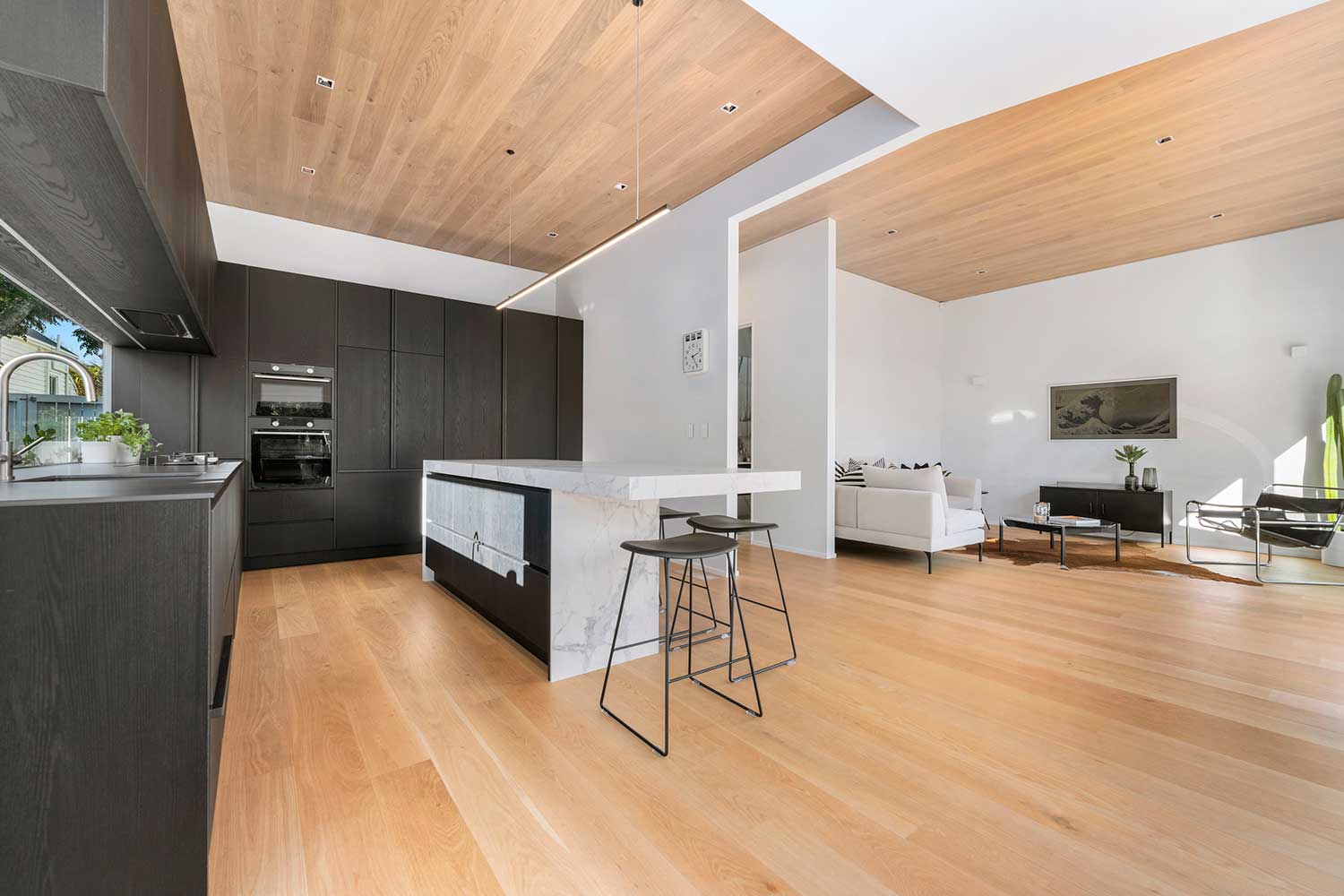
We've seen this play out in all sorts of ways. At Lisa + David's Ponsonby villa, one of the biggest obstacles was a beam that ran low through the middle of the kitchen and dining space, visually chopping the room in half. Rather than working around it, we raised it – and the effect was dramatic. From the front door, you can now see all the way through to the back of the house. It changed the entire feel of the home. Velux skylights were added to pour natural light into what had been a pretty dark space, and the kitchen island became the centrepiece of a genuinely open-plan living area.

At Jeff + Erin's heritage villa in Freemans Bay, the approach was more ambitious – the house was lifted, and the rear was extended to create a spacious lounge that opens directly out to a large deck and pool. It's a completely different relationship with the backyard, and it came from simply rethinking where the back of the house ended.

What a Villa Kitchen Renovation Does for Your Home
The most immediate change is how you use the space day to day. Cooking stops being an isolated activity. You're part of the conversation when people are over. The kids can be at the table while you're at the bench. Mornings feel different when there's light coming in.
Beyond the lifestyle gain, opening up a villa kitchen tends to add real value to the property. Auckland and Waikato buyers respond well to open-plan living, particularly when it's done well and the heritage character of the villa is respected rather than stripped out. It's one of those renovations that genuinely pays back.
For Dan + Michelle's Ponsonby villa, opening up the rear of the home to create open-plan living was central to making a century-old villa feel like a genuine family home for the way they actually live. The result was good enough to be accepted into Revere Magazine, the New Zealand Certified Builders' showcase publication.
What You'll Need to Think About in Your Villa Kitchen Renovation
A few practical things to have on your radar before you start.
Structural work. Most villa kitchen renovations involve at least some structural element – a wall, a beam, a post. This needs to be assessed by a structural engineer, and the work needs to be done by licensed builders. It's not optional, and skipping it creates real problems down the track.
Building consent. Any structural changes require a building consent through your local council. In Auckland, that process typically takes anywhere from six to twelve weeks, so it needs to be factored into your timeline well in advance. Hamilton City Council and Waikato District Council have their own processes, though timelines are broadly similar. Your builder should be across this from day one.
Heritage overlays. If your villa sits in a special character zone or has a heritage overlay – common in Ponsonby, Grey Lynn, Freemans Bay, and parts of Mt Eden, as well as heritage streets in Hamilton – there are rules about what you can and can't change, particularly on the street-facing side of the house. This doesn't mean you can't open up the kitchen; it just means the process needs to be managed carefully. We've done it many times.
What it costs. This depends heavily on what's involved. A kitchen renovation that removes a wall and reconfigures the layout – without extending the footprint – will typically sit in a different bracket to one that adds floor area or involves significant structural work. As a rough guide, a well-executed villa kitchen renovation generally sits somewhere between $60,000 and $150,000+, depending on scope, materials, and whether you're extending. That's a wide range, and the best way to understand your specific situation is to get a proper assessment early.
Is a Villa Kitchen Renovation Worth It?
For most villa owners, yes – genuinely. The kitchen is the room you spend the most time in, and it has the biggest impact on how your home feels to live in. Getting it right changes everything from your morning routine to how much you enjoy having people over.
The key is going in with realistic expectations, a clear plan, and the right builder alongside you. Villa kitchens come with quirks. Beams end up in inconvenient places, floor levels don't always match, and once walls come down you sometimes find things you weren't expecting. A good team handles those moments without drama.
If you're sitting in your villa kitchen right now wondering whether it could be better – it probably can. Whether you're in Auckland or the Waikato, we're happy to have a look and tell you honestly what's possible.